
Curious Titans Explains | Book Review
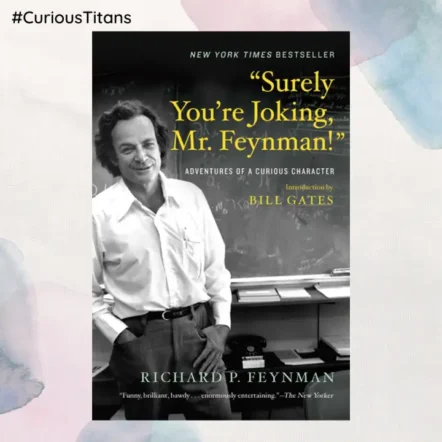
Book Review: Surely You’re Joking, Mr. Feynman! by Richard Feynman

Have you watched The Big Bang Theory? Now imagine Sheldon Cooper was a real person. Super smart, a bit strange, obsessed with puzzles, always questioning everything. Only funnier, and with an actual Nobel Prize.
That’s pretty much Richard Feynman.
Surely You’re Joking, Mr. Feynman! is a collection of stories from his life. And let me tell you upfront, it’s not a physics book. There are hardly any equations in it. It’s a book about curiosity, told by one of the most curious people who ever lived.
- Book: Surely You’re Joking, Mr. Feynman!
- Author: Richard P. Feynman
- Published: 1985
- Genre: Memoir, Science
- Read it if: you like funny true stories and people who never stop asking “why?”
Who was Richard Feynman?
Feynman was an American physicist, born in 1918 in Queens, New York. As a boy, he fixed radios for people in his neighbourhood. Later, when he gave his first ever seminar at Princeton, Albert Einstein, Wolfgang Pauli and John von Neumann were sitting in the audience. (Most of us get nervous presenting to our own team.)
In 1965, he shared the Nobel Prize in Physics with Julian Schwinger and Sin-Itiro Tomonaga for their work in quantum electrodynamics, or QED. Don’t get scared by the name. In simple words, QED explains how light and matter talk to each other. Feynman’s way of solving it was to draw little pictures of particles bouncing off each other. Physicists still use these Feynman diagrams today.
When a reporter asked him to explain his work in simple terms, Feynman said there must be a way, “But I don’t know what it is.” 😄 That sense of humour runs through every page of this book.
What is Surely You’re Joking, Mr. Feynman! about?
Feynman didn’t really sit down and write this book. Over several years, he told his stories to his friend and drumming partner, Ralph Leighton, who recorded them and shaped them into a book. That’s why it reads like a conversation. It feels like Feynman is sitting across from you, telling you these stories over a cup of tea.
It’s not a regular autobiography either. There’s no neat timeline of his life. Instead, it’s a set of short, funny stories from his childhood in Far Rockaway, his student days at MIT and Princeton, his time on the atomic bomb project at Los Alamos, and later years at Cornell and Caltech, with a long detour to Brazil.
In between, he learns to draw and sells his art under a fake name, plays in a samba band in Rio, picks locks, and gets into trouble with almost every kind of authority. Each story is a few pages long, so you can pick it up and put it down easily.

Some Stories from the book
The boy who fixes radios by thinking. As a kid, Feynman repaired radios for neighbours. One customer got irritated because the boy just paced around thinking instead of doing something. Then Feynman fixed it, and the man went around telling people this kid “fixes radios by thinking.” Think first, then act. That’s Feynman in one line.
Cracking safes at Los Alamos. During World War II, while working on the top-secret atomic bomb project, he started picking locks and cracking the safes that held classified documents. 🔐 Not to steal anything. He just loved puzzles. What he found was funny and a little scary: often the weak point wasn’t the lock, it was people who never changed the factory setting or wrote the combination down somewhere.
The wobbling plate. At one point Feynman felt burnt out and thought he was done with physics. So he decided to just play with it, for fun, with no pressure. In the Cornell cafeteria, someone tossed a plate in the air and he noticed how it wobbled while spinning. He worked out the maths just because he was curious. That playing around led him back to the work that eventually won him the Nobel Prize. I love this one. Sometimes the best work comes when we stop chasing results.
Teaching in Brazil. This was the most relatable part for me as an Indian reader. Feynman spent time teaching physics in Brazil and found that students could recite definitions perfectly, but couldn’t use them to explain anything in the real world. They had memorised, not understood. Reading this, I couldn’t help thinking about our own exam system and how much of it rewards rote learning.
Judging books by their covers. Later, he was on a committee choosing maths textbooks for schools in California. He actually read all the books (which was apparently unusual). In one case, a book was sent for review with blank pages inside, and some members still gave it a rating. If you’ve ever wondered how decisions really get made in big systems, this story will make you laugh and worry at the same time.
Get 'Surely You're Joking, Mr. Feynman'
The rule for life at the end of the book
The book ends with “Cargo Cult Science”, his 1974 commencement speech at Caltech. It has his most famous line:
“The first principle is that you must not fool yourself – and you are the easiest person to fool.”
We’re surrounded by WhatsApp forwards, reels and very confident opinions, and it’s easy to believe whatever we already wanted to believe. Feynman is saying that the person you should doubt the most is yourself. For me, that’s what critical thinking really is.
My Honest take on the ‘Surely You’re Joking, Mr. Feynman!’
What I liked about the book
It’s genuinely funny. I don’t laugh out loud at books often, but this one got me more than once.
It also makes curiosity look like the most fun thing in the world. After reading it, you want to take things apart, ask silly questions and figure out how stuff works. And you don’t need to know any physics to enjoy it.
What didn’t age well
To be honest, not every story has aged well. Some stories also come across as Feynman showing off a bit. His fellow physicist Murray Gell-Mann once joked that Feynman spent a lot of effort creating stories about himself. Read it keeping in mind that it’s one man telling his own stories, his way.
If you liked it, read this next: What Do You Care What Other People Think?
This is the follow-up book, again told to Ralph Leighton and published in 1988. It’s more personal than the first one.
The first part is about his love story with his high school sweetheart, Arline Greenbaum. He married her even though she had tuberculosis, which was almost a death sentence back then. She died in 1945, while he was working at Los Alamos. Even the book’s title is something Arline used to say to him.
The second part takes you inside the investigation of the Challenger space shuttle disaster of 1986. In a televised hearing, Feynman dipped a piece of the shuttle’s rubber O-ring seal into a glass of ice water and showed that it went stiff in the cold. That simple demo helped the whole world understand what went wrong. (To be fair, others had suspected the O-rings before him, but his demo made it impossible to ignore.)
If Surely You’re Joking makes you laugh, this one will move you.
Buy What Do You Care What Other People Think? on Amazon
Who should read Surely You’re Joking, Mr. Feynman!?
You don’t need to be a scientist. If you’re curious, this book is for you.
I’d especially recommend it to students, to parents looking for a good book for their teenagers, and to anyone who feels they’ve lost the joy of learning along the way. Start with this one, and if you enjoy it, pick up What Do You Care What Other People Think? next.
Final thoughts
Sheldon Cooper is a TV character. Feynman was real, and I’d say he was a lot more fun.
This book is a good reminder that being brilliant and being playful can go together. And curiosity isn’t just for scientists. It’s a way of living.
Get your copy of Surely You’re Joking, Mr. Feynman!:
Get 'Surely You're Joking, Mr. Feynman'
I’ve also made a short video on Feynman for the Curious Titans Instagram page as part of the Curious Titans Explains series, so do check it out. And tell me in the comments which Nobel laureate I should pick next. 👇
View this post on Instagram
#ReadBetter #BookReview #CuriousTitans #CuriousTitansExplains #RichardFeynman
Check out similar book reviews
Book Review: Poor Economics for Kids by Esther Duflo and Cheyenne Olivier