
Curious Titans Explains | Book Review
Book Review: Thinking, Fast and Slow by Daniel Kahneman
- Book: Thinking, Fast and Slow Book Review
- Published: 2011
- Page: 624
- Genre: Psychology , Science
Let’s start with a quick puzzle. A bat and a ball together cost ₹110. The bat costs ₹100 more than the ball. How much is the ball.
Take a second.
If you said ₹10, your brain just tricked you. The answer is ₹5. (Check it: a ₹5 ball plus a ₹105 bat makes ₹110, and the bat is exactly ₹100 more.)
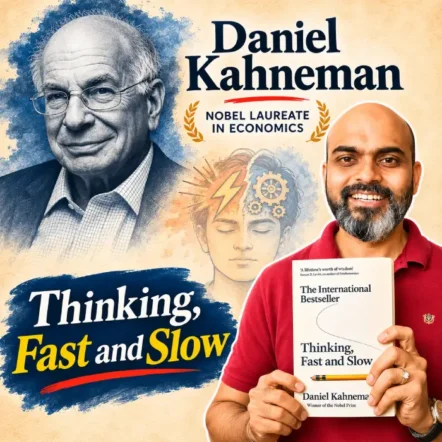
Most people get this wrong. And the man who explained why won a Nobel Prize. His book, Thinking, Fast and Slow, is one of the most influential books of our time.
View this post on Instagram
Who Was Daniel Kahneman?
Daniel Kahneman was a psychologist. He never took a single economics class. Yet in 2002, he won the Nobel Prize in Economics. Why would a psychologist win an economics prize?
Because economics had a big assumption: people are rational. We weigh our options and pick the best one. Kahneman, along with his close friend Amos Tversky, proved that we don’t.
Why Daniel Kahneman won the Nobel Prize
Kahneman and Tversky showed that we take mental shortcuts. These shortcuts save time, but they also make predictable mistakes.
One of their most famous findings is about loss. Losing ₹1,000 hurts about twice as much as winning ₹1,000 feels good. That one idea explains a lot. Why we hold on to a falling stock. Why we hate cancelling a subscription we never use. Why “limited time offer” works so well on us.
There’s a sad and beautiful part to this story. Tversky died in 1996, and the Nobel is not given after death. Kahneman always said the prize belonged to both of them.

System 1 and System 2: The Two Systems in Your Head
The heart of Thinking, Fast and Slow is a simple idea. There are two systems running in our head.
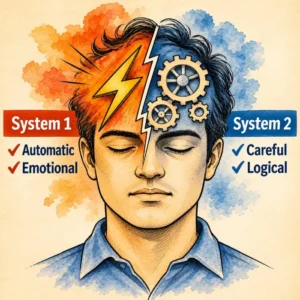
System 1 is fast. It is automatic, emotional and always on. It’s the one that shouted “₹10!” before you even finished reading the puzzle.
System 2 is slow. It is careful and logical. But it is also lazy. It only shows up when you force it to.
Most of the day, System 1 runs the show. That’s fine for small things, like recognising a friend’s face or driving on an empty road. The trouble starts when we let System 1 make the big calls.
Buy Thinking Fast and Slow on Amazon
How This Book Changed the Way I Make Decisions
When I read this book, it felt like an alarm. One that rings every time I’m about to make a decision.
- Should I trust that breaking news?
- Should I buy that fancy item?
- Should I make that investment?
Now I pause and ask myself one question: Is this System 1 talking?
That small pause has saved me from more than a few bad decisions.
Should You Read Thinking, Fast and Slow?
Yes, but go in with the right expectations. Thinking, Fast and Slow (2011) is not a quick read. It’s long, and some chapters need patience. Read it slowly, a few chapters at a time. Let System 2 do the work.
In return, it will change how you think about thinking.
Read it if you:
- Want to make better money and life decisions
- Enjoy psychology, behavioural economics or critical thinking
- Have ever wondered, “Why did I do that?”
👉 Get Thinking, Fast and Slow on Amazon
Buy Thinking Fast and Slow on Amazon
Final Thought
The next time your brain gives you an answer in a split second, smile and ask: is this System 1 talking?
This post is part of Curious Titans Explains, where we decode Nobel laureates, what they won for, and the books they left us. Follow Curious Titans on Instagram and YouTube for more.
Buy Thinking Fast and Slow on Amazon
#ReadBetter #BookReview #CuriousTitans #CuriousTitansExplains #NobelPrize
Check out similar book reviews
Book Review: Surely You’re Joking, Mr. Feynman! by Richard Feynman